
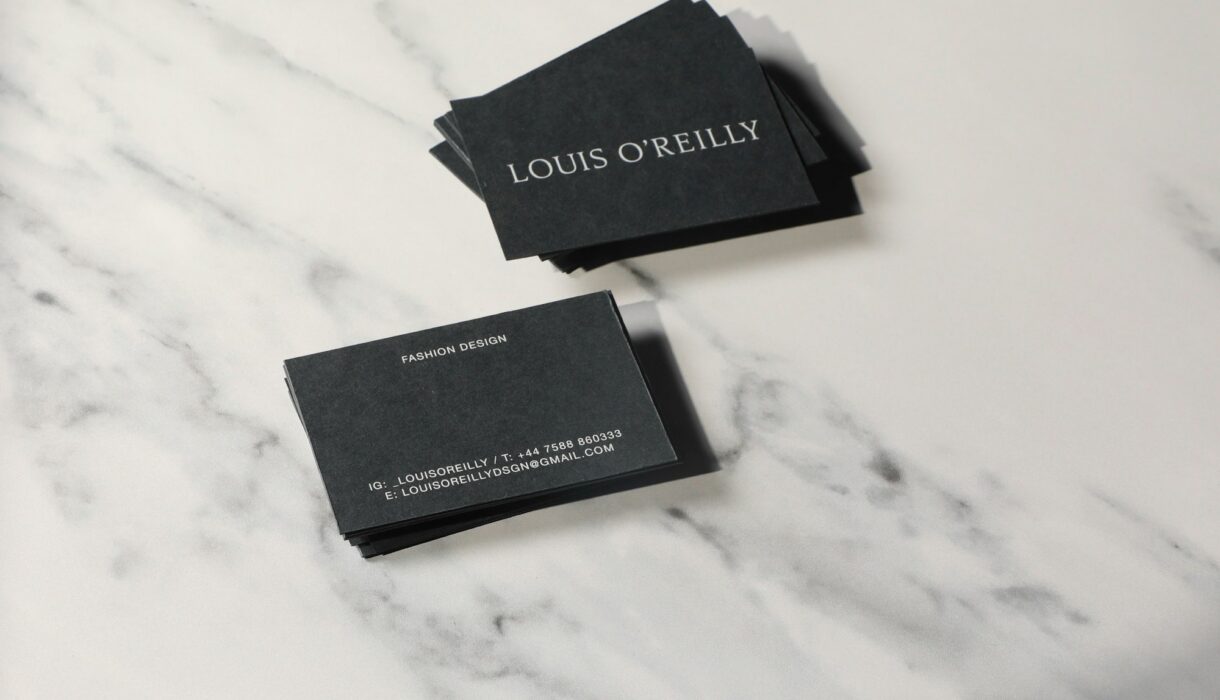

You can tell a lot about a business card before you’ve read a word on it. Pick one up and you notice straight away whether it’s thin and floppy or solid in your hand, whether it’s shiny or soft, whether the corners have already started to curl. People make a quick judgement from that, and it sticks to the business whether it’s fair or not.
So when we design business cards, we spend almost as much time on the paper as on the layout. Here’s a quick guide to what we look at.
Weight
Paper weight is measured in gsm, grams per square metre. Higher means thicker and stiffer. For business cards:
- 300 to 350 gsm is the standard. It feels fine and works for most businesses.
- 400 gsm and above feels noticeably more substantial. It’s what we usually recommend if the card is a key part of how you present yourself, say for consultants, lawyers or anyone in a client facing role.
- Below 300 gsm starts to feel cheap. We’d avoid it for anything except very short runs or temporary cards.
Finish
The surface changes how a card feels and how colours look on it.
Matte and uncoated stocks feel soft and a bit more understated. They’re easy to write on, which is useful if you ever scribble a number on the back. Colours come out slightly softer.
Gloss makes colours punchy and photos look sharp, but shows fingerprints and can feel a little less premium. It’s fine for some brands, less so for others.
Soft touch or velvet lamination has that slightly rubbery feel that people tend to rub between their fingers. It’s a nice detail and it protects the card, but it adds cost.
Extras worth considering
Spot UV, foil, embossing and rounded corners can all lift a card, used carefully. One extra is usually enough. A card with gold foil, spot UV, embossing and rounded corners all at once starts to feel like it’s trying too hard.
Ask for a sample
Screens can’t show you how paper feels. Before printing a full run, ask the printer for a sample of the stock or, better still, a short proof run. We usually bring a few paper samples to the design meeting so clients can hold them while we talk through options.
If you’re redoing your cards or full stationery set, our business stationery page shows some recent work, and you’re welcome to get in touch for a chat about stock and finishes.
Header photo by Julian Tong on Unsplash.